
Author: admin

  • How Anatomy Training Makes Every Device Work Better in Your Hands

    How Anatomy Training Makes Every Device Work Better in Your Hands

    Most surgical device training teaches you how to use the instrument. It covers insertion technique, instrument sequencing, and what the end result should look like on imaging. What it frequently skips is the anatomical context that makes the difference between technically correct and clinically excellent.

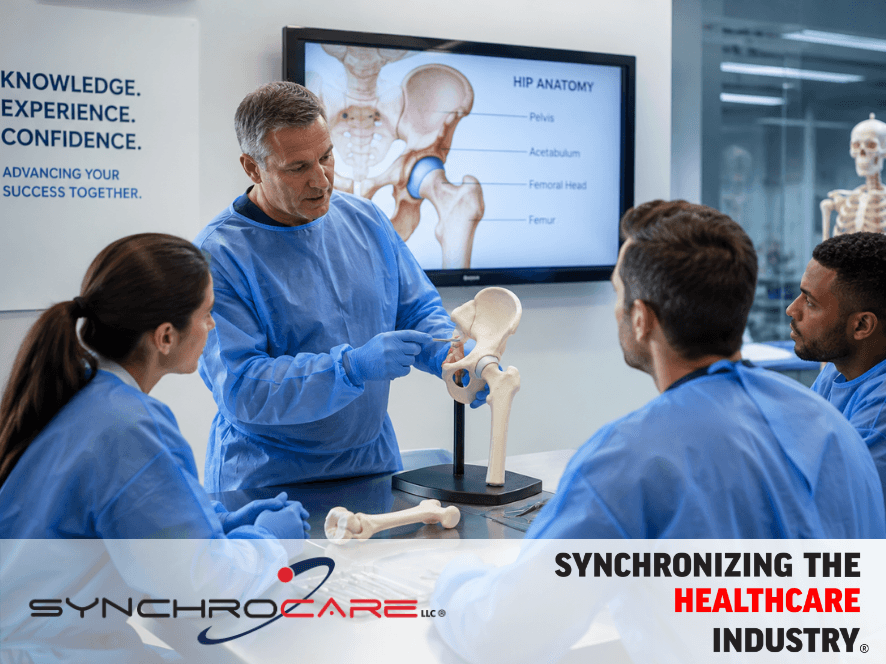
    A surgeon who understands not just the steps of a procedure but the specific anatomical variables that affect how a device behaves in different patients makes better intraoperative decisions. So does the scrub tech who understands the procedure well enough to anticipate what comes next. Anatomy training is not a prerequisite for using a device. It is a prerequisite for using it well.


    Why procedure-specific anatomy changes how devices perform

    Every device performs within a biological environment that varies by patient. Bone density, soft tissue compliance, joint geometry, and the degree of degeneration all affect how an implant sits, how an instrument handles, and how the repair holds over time. A team trained only on the instrument steps works from a script. A team trained on the underlying anatomy reads the room.

    This distinction shows up most clearly in complex cases, where anatomy is atypical, where prior surgery has changed the local tissue environment, or where a patient’s age and bone quality require a different approach. The surgeons and clinical staff who navigate those cases confidently are the ones whose training went deeper than the product IFU.


    How Synchrocare approaches anatomy training

    Synchrocare’s medical sales consultants complete training that includes procedure-relevant anatomy alongside product knowledge, surgical technique, and compliance standards before they enter any facility. The goal is not to train reps to perform surgery. It is to ensure that every clinical conversation they have is grounded in an understanding of the anatomy the device is designed to work within.

    That depth changes the quality of the in-service. When a medical sales consultant training program prepares its people to discuss the anatomical rationale behind a device’s design, not just its features, surgeons and clinical staff receive information they can apply directly to patient selection and intraoperative decision-making. That is the standard Synchrocare holds across every product in its portfolio.


    Building a clinical team that adapts as your device portfolio grows

    Hospital staff development programs that include anatomy training as a component of device competency build teams that transfer knowledge across products. A scrub tech who understands the anatomy of the foot and ankle adapts more quickly to a new fixation device in that space. A circulating nurse who understands the cervical spine is a more effective support for a spine surgeon introducing new instrumentation.

    Synchrocare supports this ongoing education through technique guides, case studies, and in-service resources that go beyond product setup. Medical sales consultants remain available for clinical support long after the initial training, providing the kind of continuity that builds team competency over time rather than delivering it in a single session and walking away.


    To learn more about Synchrocare’s clinical support and training resources, visit www.synchrocare.com.

  • What the Right Orthopedic Distribution Partner Brings to Your Product Launch

    What the Right Orthopedic Distribution Partner Brings to Your Product Launch

    General medical supply distribution is a logistics business. Products move from manufacturer to facility on the strength of contracts, pricing agreements, and delivery schedules. The rep’s job is to maintain the relationship and process the orders. For commodity medical supplies, that model works well.

    Orthopedic device distribution is a different business entirely. The product is complex, the clinical environment is demanding, and the relationship between the device and the surgeon who uses it requires a level of support that a logistics-first distribution model cannot sustain. If you are an orthopedic device manufacturer evaluating distribution partners, understanding that difference is where the decision starts.


    The clinical knowledge requirement

    An orthopedic device representative who cannot speak credibly about the anatomy relevant to a procedure, the surgical technique the device supports, or the clinical scenarios where the device performs differently than expected is not a distribution asset. They are a liability. Surgeons have limited time and high standards. A rep who cannot meet them at that level does not get a second meeting, and neither does your product.

    Synchrocare’s medical sales consultants complete comprehensive training on product knowledge, procedure-relevant anatomy, surgical technique considerations, and the full compliance framework governing medical device sales before they represent any product. That preparation is what earns a standing in the facilities where your device needs to perform. It is also what protects your clinical reputation in the field.


    The compliance infrastructure orthopedic manufacturers cannot overlook

    Orthopedic device distribution operates within a strict regulatory environment. The AdvaMed Code of Ethics, the Stark Law, the Anti-Kickback Statute, and the False Claims Act all govern how devices are sold, how surgeons are engaged, and how facilities are accessed. A distributor whose representatives are not trained and accountable on these standards creates legal and reputational exposure that travels directly back to the manufacturer.

    Every Synchrocare medical sales consultant undergoes a thorough background check, maintains appropriate insurance, and is trained on every applicable compliance standard before entering any facility. All medical device distribution and support activities are conducted in full compliance with applicable regulations and industry standards. For manufacturers who have spent years building a product and a reputation, that compliance foundation is not optional. It is the baseline.


    National reach backed by clinical infrastructure

    A distributor that claims national coverage but lacks active relationships with hospitals, ambulatory surgery centers, group purchasing organizations, and integrated delivery networks delivers geography without access. Synchrocare has built those relationships across Ohio, Kentucky, and Indiana, with national expansion underway through its franchise network. Every franchise owner enters the market trained, compliant, and supported by Synchrocare’s established clinical and back-office infrastructure.

    For manufacturers evaluating medical device market expansion, that means your product reaches clinical decision-makers through representatives who are already credentialed, trusted, and operating within the compliance framework the facilities require. The groundwork is already in place. What Synchrocare adds is the clinical depth that makes the reach meaningful.


    To learn more about partnering with Synchrocare as your specialty medical device distributor, visit www.synchrocare.com.

  • OSSIO: The Case for an Implant That Becomes Bone and Leaves Nothing Behind

    OSSIO: The Case for an Implant That Becomes Bone and Leaves Nothing Behind

    Ask a patient what they want from a fixation implant, and the answer is almost always the same: they want it to work and to stop thinking about it. The challenge with permanent metal hardware is that it does not always allow for the second part. Metal implants stay in the body indefinitely, and in roughly one in four cases of foot and ankle surgery, they require a second procedure to remove them. Data on file at OSSIO.

    OSSIO was founded in 2014 with a specific goal: to replace metal as the standard of care in orthopedic fixation. The technology they developed to do it, OSSIOfiber Bio-Integrative Implant Technology, does something no metal implant can. It gradually becomes bone.


    How OSSIOfiber works differently from every other fixation material

    OSSIOfiber is not bioresorbable. That distinction matters. Conventional bioresorbable implants break down over time but do not integrate meaningfully with bone, and they carry documented risks of adverse inflammation, foreign body reaction, and cyst formation during degradation. OSSIOfiber takes a fundamentally different path.

    The material combines a continuous natural mineral fiber matrix with a PLDLA mixture. The mineral fibers are the same natural minerals found in bone. When implanted, OSSIOfiber begins a gradual bio-integration process: early bone attachment is seen in as little as two weeks post-surgery, followed by progressive tissue ingrowth and incorporation until the implant is completely replaced by healthy bone. According to pre-clinical studies, full integration is complete in roughly 78 to 104 weeks. Data on file at OSSIO. Nothing permanent is left behind.

    OSSIO describes the result as stronger than cortical bone, stronger and more predictable than polymers alone, and without the foreign body reactions, stress-shielding, or removal risks commonly associated with permanent metal hardware.


    The product range: foot, ankle, and beyond

    OSSIOfiber is commercially available in the United States and FDA 510(k) cleared. The current product range spans compression screws, compression staples, trimmable fixation nails, hammertoe fixation systems, and suture anchors. Clinical applications cover foot and ankle procedures, including bunion correction, hammertoe repair, and arthrodesis, as well as hand and wrist surgery and sports medicine applications, including the Brostrom repair.

    The OSSIOfiber Compression Screw is indicated for maintenance of alignment and fixation of bone fractures, comminuted fractures, fragments, osteotomies, arthrodesis, and bone grafts of the upper extremity, fibula, knee, ankle, and foot. It delivers superior performance to conventional metal screws in vitro initial compression strength testing and in vitro pull-out strength testing of the 3.5x26mm format. Data on file at OSSIO.

    A recent clinical study reported that 100% of hammertoe patients treated with OSSIOfiber were satisfied and would recommend it to others. Data on file at OSSIO. The implant works with existing reimbursement codes and surgical techniques, which means adoption does not require a complete change in how a surgeon operates.


    What this means for surgeons considering OSSIOfiber

    The practical value for surgeons is threefold. First, it eliminates the clinical conversation about hardware removal before surgery begins. Second, it provides MRI-safe, artifact-free imaging on both CT and X-ray throughout the healing process, giving surgeons a clear view of bone healing without obstruction. Third, it addresses metal sensitivity directly. Approximately one in four people have metals removed in a second operation, and metal allergy is a documented concern in orthopedic practice. OSSIOfiber provides a nickel-free solution with no permanent hardware remaining.

    Synchrocare distributes OSSIO products as part of its national specialty medical device portfolio, supporting surgeons and healthcare facilities through trained medical sales consultants and ongoing clinical resources.


    To learn more about OSSIO products available through Synchrocare, visit www.synchrocare.com.

  • Why Price-Only Procurement Leaves Value on the Table for GPOs and IDNs

    Why Price-Only Procurement Leaves Value on the Table for GPOs and IDNs

    Group purchasing organizations and integrated delivery networks exist to give healthcare systems leverage in the supply chain. That leverage is most often applied to price, and rightly so. Cost control is a legitimate operational priority. But price-only procurement decisions in medical devices create a different kind of cost that rarely appears on the same spreadsheet.

    When a device enters a facility without adequate clinical support, without a compliant representation, or without the infrastructure to back it up after the sale, the downstream cost falls on clinical staff, procurement teams, and ultimately patients. The right distributor relationship removes that risk. The wrong one multiplies it.


    What a full-service distributor relationship actually delivers

    Synchrocare was founded with a specific mission: to bring innovative, FDA-approved medical devices to hospitals, ambulatory surgery centers, group purchasing organizations, and integrated delivery networks through a distribution model that lowers cost and complexity rather than adding to it. That means more than competitive pricing on a product list.

    It means medical sales consultants who have completed rigorous compliance training, including the AdvaMed Code of Ethics, the Stark Law, the Anti-Kickback Statute, and the False Claims Act, before entering any facility. It means back-office infrastructure that handles order management and customer service reliably. It means clinical support that continues after the sale, including technique guides, case studies, and in-service training that keep surgical teams competent on the devices they use.


    The compliance dimension GPOs and IDNs cannot afford to overlook

    Vendor compliance is a growing audit priority across hospital systems and integrated delivery networks. A distributor whose representatives are not properly credentialed, insured, or trained creates institutional exposure that lands on the facility’s compliance desk. Every Synchrocare medical sales consultant undergoes a thorough background check, maintains insurance in line with industry standards, and completes compliance training before entering any facility. All distribution and support activities are conducted in full compliance with applicable regulations and industry standards.


    Clinical support that reduces administrative burden

    For procurement officers managing device introductions across multiple facilities or specialties, distributor-provided clinical support reduces the coordination burden on in-house staff. Synchrocare provides case studies, product brochures, technique guides, and FAQs as part of every product partnership, and medical sales consultants remain available for clinical questions long after the initial in-service. That continuity means fewer gaps in staff competency and fewer calls to procurement when a question arises in the OR.

    For hospital and ASC administrators evaluating distributor relationships, the question worth asking is not just what does this device cost per unit, but what does it cost when the support structure around it is inadequate. Synchrocare’s model is built to make that second number as close to zero as possible.


    To learn more about how Synchrocare works with hospitals, ambulatory surgery centers, GPOs, and IDNs, visit www.synchrocare.com.

  • SurGenTec: Engineering Spine and Orthopedic Solutions From the Surgeon’s Point of View

    SurGenTec: Engineering Spine and Orthopedic Solutions From the Surgeon’s Point of View

    Spine surgery is technically demanding, anatomically unforgiving, and clinically consequential. Patients arrive with complex pain histories and high expectations. Surgeons need instruments and implants that match the precision the environment demands. SurGenTec was built with that reality in mind.

    SurGenTec is a privately owned medical device company headquartered in Boca Raton, Florida, focused on developing and manufacturing innovative products with patient and surgeon safety at the center of its design process. The company collaborates directly with experienced surgeons and leading experts to continuously improve the design and engineering of its products, a philosophy that shows up clearly in how each product in its portfolio is structured.


    SI joint fusion: the TILINK-P system

    Sacroiliac joint dysfunction is a significant source of lower back and pelvic pain, and SI joint fusion is an increasingly common surgical solution. The TILINK-P is SurGenTec’s minimally invasive SI joint fusion system, designed for a true posterior approach with a novel transfixing compression anchor.

    Key features of the TILINK-P include Nanotex Surface Technology, a hydrophilic surface that uses ionic bonds to attract and hold bone marrow aspirate and other fluids that may contain key growth factors. The system’s open trellis design incorporates 500 to 750 micron openings to help promote bony ingrowth throughout the screw. The design is engineered to resist all SI joint forces including shear, nutation, counter-nutation, compression, and distraction, and allows for up to 5cc of biologic post-packing.


    Cervical stabilization: the ION-C system

    The ION-C is SurGenTec’s posterior cervical facet fixation system, designed for controlled, non-impact placement and precise stabilization across one or two levels from C3 to C7. It features a zero-profile implant design, in-situ implant depth adjustment, and no percussion on insertion, which maintains a neutral joint position and minimizes the risk of joint expansion.

    The ION-C also incorporates Nanotex Surface Technology for osseointegration promotion, with fenestrations and open barrels designed to allow bone graft integration and fusion. Instrument configurations include both single-use sterile and reusable non-sterile options to fit different facility preferences.


    Bone grafting: the OsteoFlo family

    SurGenTec’s OsteoFlo product line addresses bone void filling across spine and extremity applications. OsteoFlo HydroFiber is FDA-cleared as equivalent to autograft across all levels of the spine and is uniquely indicated for use in cases involving tumors, cysts, osteomyelitis, fractures, and trauma. Its web interlace technology produces web-like fibers interwoven with porous synthetic particles that, when hydrated, form a cohesive structure that enhances handling and resists migration under irrigation.

    The broader OsteoFlo family includes NanoPutty and HydroPutty formulations, giving surgeons multiple consistency and delivery options depending on the specific case requirements. SurGenTec also offers the GraftGun for controlled biologic delivery and the 3D GraftRasp for graft site preparation.


    A portfolio built around one principle

    SurGenTec describes its mission as developing intuitive solutions to improve the quality of life for patients, and the product portfolio reflects that directly. Each system is designed to reduce complexity in the OR, support the body’s natural healing processes, and give surgeons reliable options for procedures where precision matters most. Synchrocare distributes SurGenTec products as part of its national medical device portfolio, supporting surgeons and healthcare facilities with trained clinical representation.


    To learn more about SurGenTec products available through Synchrocare, visit www.synchrocare.com.

  • The Hidden Cost of Building a Medical Device Territory You Will Never Own

    The Hidden Cost of Building a Medical Device Territory You Will Never Own

    Fifteen years into a medical device sales career, most reps have something impressive to show for their work. Strong surgeon relationships built over hundreds of cases. A territory they developed from a standing start. A clinical reputation that took years and real effort to earn. What many of them do not have is any of it documented in their name.

    When a traditional medical sales rep leaves a company, the territory stays. The relationships belong to the employer. The book of business gets reassigned before the exit interview is finished. That is not a cynical take on the industry. It is the structural reality of how most medical device sales roles are designed, and it is worth understanding clearly before spending another decade building someone else’s asset.


    Ownership changes the quality of the work

    The Synchrocare franchise model was built on a straightforward observation: an owner-operator represents products differently than a salaried employee. Not because they work harder in some abstract sense, but because the stakes are structured differently. When the relationship is yours, the follow-through is different. When the territory belongs to you, you protect it.

    As a Synchrocare franchise owner, you have access to an established portfolio of FDA-approved medical devices, a proven medical sales consultant training program, back-office and compliance infrastructure, and the purchasing power that comes with being part of a national medical device distribution network. The foundation is already in place. What you build on top of it is yours.


    Who this model is built for

    Synchrocare is deliberate about who it brings into the franchise network. The profile is specific: someone who builds relationships quickly and easily, demonstrates a strong sales background, is confident speaking with surgeons, hospital administrators, and clinical staff, learns highly technical material fast, and holds themselves to a high standard of compliance and professional ethics.

    That is not a list designed to be exclusive for its own sake. It is a list that reflects what it actually takes to operate effectively in medical device sales. Every owner in the network operates to the same standard, which is what makes the network worth being part of.


    What the training covers before you enter the field

    No Synchrocare franchise owner enters the market without completing a comprehensive training program first. That program covers the full product portfolio, relevant anatomy by procedure, surgical technique considerations, and the complete compliance framework, including the AdvaMed Code of Ethics, the Stark Law, the Anti-Kickback Statute, and the False Claims Act. Background checks and insurance requirements are standard.

    The goal of that training is not box-checking. It is clinical credibility from day one. A franchise owner who walks into a hospital prepared earns trust faster and protects the territory better. That preparation is what the Synchrocare franchise model is built around.


    To learn more about the Synchrocare medical device franchise opportunity, visit www.synchrocare.com/franchising.

  • Diamond Orthopedic: The Fixation Technology That Starts With the Geometry of the Screw

    Diamond Orthopedic: The Fixation Technology That Starts With the Geometry of the Screw

    The helical bone screw has been the standard in orthopedic fixation for decades. The design has remained largely unchanged since its early clinical adoption: a threaded shaft that bites into bone as it turns, relying on the friction of that interface for holding strength. It works. But Diamond Orthopedic asked whether it works as well as it could, and built a company around the answer.

    Diamond Orthopedic, headquartered in Charlotte, North Carolina, is the exclusive provider of faceted threadform technology for orthopedic applications worldwide. The company’s premise is straightforward: the geometry of the screw determines the quality of the fixation, and the geometry of the traditional helical screw has room for improvement.


    What the faceted threadform actually does differently

    The faceted threadform replaces the smooth helical thread with a series of flat facets that interact with bone differently during insertion. According to Diamond Orthopedic, the unique geometry reduces friction during the insertion process and uses the naturally occurring viscoelastic properties of bone to achieve more contact at the bone-screw interface.

    The result, based on studies conducted at Orthokinetic Testing Technologies, tested in biological and non-biological test substrates, includes a nearly 50% reduction in insertional torque compared to traditional helical screws, improved purchase at the bone-screw interface, and up to 61% greater pullout strength two weeks after surgery compared to a market-leading helical screw with the same profile. Data on file at Diamond Orthopedic.

    For surgeons working in cases where bone quality is compromised, whether due to osteopenia, patient age, or the demands of revision surgery, those numbers represent a meaningful clinical difference. As Dr. Bob Anderson, MD noted about the screws: they are ideal for achieving initial compression and then maintaining the fixation, particularly when dealing with a patient with compromised bone.


    The product range: sterile and non-sterile options

    Diamond Orthopedic offers its faceted bone screw technology in both sterile and non-sterile formats, addressing the supply chain and preference needs of different surgical environments. The product range includes small screw sets suited to hand surgery, fracture fixation of small bones, and small joint fusions, as well as larger cannulated screw sets indicated for fracture fixation of large bones and large bone fragments, including ankle arthrodesis, femoral neck fractures, tibial plateau fractures, and sacroiliac joint disruptions.

    The company is made in the USA and positions itself as the new fixation standard in orthopedics. Synchrocare distributes Diamond Orthopedic products nationwide, supporting appropriate product use through trained medical sales consultants and ongoing clinical support.


    What surgeons say

    John G. Seiler III, MD, described Diamond Orthopedic’s faceted screws as a great innovation in screw design, citing the reduced torque of insertion and size variety as making them a strong choice for both fracture fixation and small joint fusions in the hand. The design’s performance in compromised bone has been a consistent theme among surgeons who have used the technology clinically.


    To learn more about Diamond Orthopedic products available through Synchrocare, visit www.synchrocare.com.

  • What Happens in the OR When a Surgical Team Was Never Properly Trained on a Device

    What Happens in the OR When a Surgical Team Was Never Properly Trained on a Device

    Nobody announces a training gap before a procedure. It surfaces in the room. A scrub tech hesitates when asked for an instrument they have handled twice. A circulating nurse is unsure of the correct configuration. The surgeon pauses, asks a question, and the answer is slow in coming. The case continues, but something has shifted.

    Surgical device training failures do not always produce adverse events. Often, they produce something more insidious: hesitation, inconsistency, and eroded confidence that accumulates across cases until a device gets quietly abandoned. Not because it failed clinically. Because the team around it was never fully prepared.


    The anatomy gap nobody talks about

    Most surgical device training focuses on how to use the instrument. Fewer programs invest enough time in why certain anatomical considerations affect how the device performs in specific patients. A scrub tech who understands the anatomy relevant to a procedure handles instruments with a different kind of precision. A circulating nurse who understands the clinical context of a device anticipates needs before they are spoken.

    Synchrocare’s medical sales consultants are trained to provide anatomy training relevant to the procedures their products are used in, not just product walkthroughs. That clinical depth is what separates a useful in-service from one that gets forgotten by the following week.


    Inconsistency is a patient safety issue

    When surgical instrument training is inconsistent across a team, the variability shows up in case preparation, instrument handling, and procedural flow. High-volume surgical teams, where every member is fully trained, operate with a rhythm that directly benefits the patient. Teams with pockets of knowledge gaps operate with friction that adds time, increases cognitive load on the surgeon, and raises risk.

    Hospital staff development programs that include regular surgical device competency checks and hands-on medical device training sessions close those gaps before they matter. The investment is modest. The alternative is a training failure that reveals itself at the worst possible moment.


    What good hospital device training requires

    Effective surgical device training covers the full team, not just the primary user. It addresses the clinical indication, the instrumentation sequence, the anatomical considerations that affect technique, and the scenarios where the device behaves differently than expected. It is reinforced over time with refresher sessions, case studies, and readily available support resources.

    Synchrocare provides technique guides, product brochures, case studies, and FAQs alongside every product it distributes, and medical sales consultants remain available for clinical support long after the initial in-service. The standard is not a one-time handoff. It is an ongoing clinical partnership.


    The compliance piece facilities often overlook

    Healthcare facilities carry a documented responsibility to ensure clinical staff are trained on every device they operate. That training needs to be structured, consistent, and on record. Synchrocare conducts all hospital device training and clinical device workshops in full compliance with the AdvaMed Code of Ethics and applicable industry standards. For procurement teams and clinical educators building defensible staff competency programs, that compliance foundation is as important as the training content itself.


    To learn more about Synchrocare’s clinical support and surgical device training resources, visit www.synchrocare.com.

  • What Happens to Your Medical Device When Distribution Goes Right

    What Happens to Your Medical Device When Distribution Goes Right

    You spent years developing your device. The clinical validation is solid. The FDA cleared it. You have a product that addresses a real surgical need. When the right distribution partner is in place, that work finally reaches the surgeons and hospitals it was designed for.

    Strong medical device distribution is often the difference between a promising product and one that gains real traction in the market. It ensures that the infrastructure connecting the device to the surgeon actually works: the right people understand the product, the logistics are in place, and the device is available when and where it is needed. Understanding what effective distribution looks like is the first step to making sure your product reaches its full potential.


    When reps can hold a clinical conversation

    Medical device sales require more than product knowledge. It requires the ability to speak credibly about the clinical environment in which the device operates. A rep who cannot discuss relevant anatomy, surgical technique, or procedure-specific considerations does not just underperform. They actively damage the surgeon’s confidence in the product itself.

    Synchrocare’s medical sales consultants complete comprehensive training on product knowledge, relevant anatomy, surgical technique, and the full compliance framework governing medical device sales before they represent a specific product. That preparation is what earns a rep standing in the OR, and what protects your device’s clinical reputation in the field.


    When national reach has clinical depth

    A distributor that claims national medical device distribution coverage but lacks established relationships with hospitals, ambulatory surgery centers, group purchasing organizations, and integrated delivery networks is national in name only. Geography without clinical infrastructure does not move product. It creates the appearance of distribution while your device sits unused.

    Synchrocare has built active relationships across Ohio, Kentucky, and Indiana with national expansion underway through its franchise network. Every franchise owner enters the market trained, compliant, and backed by Synchrocare’s established sales, service, and clinical infrastructure. For manufacturers evaluating medical device market expansion, this means real access, not just coverage on a map.


    When post-sale support is strong

    The sale is not the finish line. Surgeon confidence in a new device builds over multiple cases, supported by a rep who is present, knowledgeable, and responsive. When post-sale clinical support disappears after the first order, product adoption stalls, and surgeons revert to what they already know.

    Synchrocare treats clinical support as a core part of every manufacturer partnership, not an optional service. Medical sales consultants provide ongoing in-service support, technique guidance, case studies, and FAQs long after the initial product introduction. That continuity of support is what turns a first case into a long-term clinical device supply agreement.


    To learn more about partnering with Synchrocare as your medical device distribution partner, visit www.synchrocare.com.

  • How Group Purchasing Organizations and IDNs Can Get More From Their Medical Device Supplier

    How Group Purchasing Organizations and IDNs Can Get More From Their Medical Device Supplier

    Group purchasing organizations and integrated delivery networks give healthcare facilities leverage. Leverage over pricing, over contract terms, and over the quality of the products entering their supply chain. But that leverage only works when the medical device supplier on the other side of the agreement can deliver on the contract’s promises.

    Too often, hospital equipment procurement decisions are made on price alone. The clinical support, compliance standards, and post-sale service that determine whether a product is used effectively within a facility are treated as secondary considerations. That gap is where problems start.


    What group purchasing organizations should demand from a medical device supplier

    A national medical device supplier working with group purchasing organizations needs to bring more than a product list and a price sheet. It needs to bring a vetted portfolio of FDA-approved medical devices, a compliance infrastructure that protects the facility, and clinical support that extends past the point of delivery.

    Synchrocare was built specifically to meet the demands of hospitals, ambulatory surgery centers, group purchasing organizations, and integrated delivery networks that need a medical device supply chain partner operating at a high standard. Since 2005, the company has provided high-quality, cost-effective medical devices and solutions to healthcare professionals and patients, with a focus on products that address genuine clinical needs rather than simply expanding volume.


    Clinical device solutions that match the facility’s actual needs

    Integrated delivery networks managing procurement across multiple facilities face a specific challenge: the products entering those facilities need to perform consistently and be supported consistently across every site. A medical device distributor that cannot provide uniform clinical support, documentation, and in-service training across a network creates compliance gaps and clinical inconsistency.

    Synchrocare’s model addresses this directly. Every medical sales consultant in the Synchrocare network completes the same comprehensive training program, operates under the same compliance standards, and provides the same quality of clinical device support. Whether a product is being introduced into a single ambulatory surgery center or across an integrated delivery network, the standard does not change.


    Hospital equipment procurement services that reduce administrative burden

    The administrative side of hospital equipment procurement is significant. Contract management, compliance verification, in-service scheduling, and post-sale support all require time and resources from procurement and clinical staff. A medical device supplier that handles these functions reliably reduces that burden rather than adding to it.

    Synchrocare provides back-office support and customer service infrastructure alongside every product partnership it forms. For group purchasing organizations and integrated delivery networks managing procurement at scale, operational reliability is as important as the product quality itself.


    Compliance is built into every transaction

    Every Synchrocare medical sales consultant undergoes a thorough background check, maintains insurance in line with industry standards, and completes training on the AdvaMed Code of Ethics, the Stark Law, the Anti-Kickback Statute, and the False Claims Act before entering any facility. All hospital equipment procurement services and distribution activities are conducted in full compliance with applicable regulations and industry standards.

    For group purchasing organizations and integrated delivery networks with strict vendor compliance requirements, Synchrocare’s standards remove the need for extensive due diligence. The compliance framework is already in place.


    To learn more about how Synchrocare works with hospitals, ambulatory surgery centers, group purchasing organizations, and integrated delivery networks, visit www.synchrocare.com.